
Full-Stack Web Development Solutions
What Is Full-Stack Development?
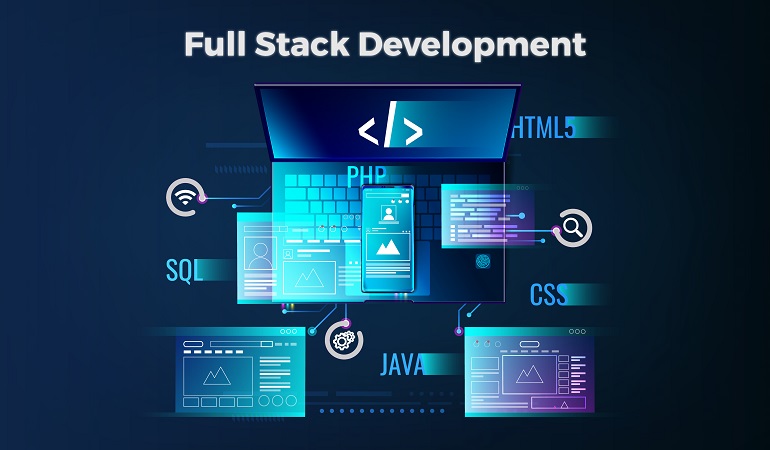
Full-stack development combines frontend, backend, and database expertise within one unified development framework. Rather than splitting efforts between specialists for every layer, full-stack developers possess a holistic understanding of how each component interconnects.
Emerging Trends in Full-Stack Web Development
By integrating these trends, full-stack solutions remain future-proof, ready to adopt technological evolutions quickly.
• Serverless Architectures: Eliminating infrastructure management with AWS Lambda or Cloud Functions.
• Headless CMS & API-Driven Frontends: Decoupling content from presentation for faster delivery.
• AI-Powered Web Apps: Integrating machine learning for predictive analytics, personalization, and automation.
• Progressive Web Apps (PWAs): Delivering app-like experiences with offline accessibility and push notifications.
Advantages of Full-Stack Web Development Services
For businesses seeking long-term digital sustainability, this unified approach drastically improves adaptability, maintenance simplicity, and innovation speed.
• Rapid Development Cycles: A single agile team seamlessly transitions between frontend and backend tasks.
• Cost Efficiency: Lower operational costs by eliminating excessive coordination and dependency on separate technologies.
• Unified Security Implementation: End-to-end encryption, secure token systems, and consistent data validation from client to server.
• Cloud-Native Scalability: Automatic horizontal scaling ensures performance stability during traffic spikes.
Integration with APIs and Third-Party Platforms
Full-stack solutions thrive on connectivity. Using XML, REST, and GraphQL APIs, applications communicate effortlessly with ERP, CRM, marketing automation, and AI analytics systems.
• An HRMS built using React (frontend) and Node.js (backend) syncs employee data with payroll software using XML feeds.
• A BPO dashboard uses a REST API gateway to exchange voice logs, tickets, and KPIs with client portals in real-time.
• These tight integrations demonstrate how full-stack frameworks act as bridges across enterprise ecosystems.
Real-World Use Cases
Each case emphasizes scalability, reduced latency, and tailored performance optimization through a unified stack.
• A fashion brand deployed a React–Node.js–MongoDB stack to manage high-volume sales, dynamic pricing, and secure payments. Conversion rates improved by 38%.
• A hospital group adopted a Python Django backend with React frontend to enable teleconsultation, patient portals, and real-time appointment scheduling.
• A customer service firm implemented a Vue.js frontend with Node.js backend, integrating voice APIs and XML feeds, automating 80% of ticket routing.
The Strategic Impact
Full-stack web development services provide more than technology they deliver digital resilience and agility. Businesses benefit from shorter time-to-market, faster updates, and lower maintenance costs while achieving superior CX (Customer Experience) and ROI outcomes.
Security-First Architecture
Security sits at the core of full-stack development services. Developers employ OWASP guidelines, encryption techniques (AES, RSA), and secure connection protocols (TLS/SSL).
Backend validation, CSRF protection, and JWT-based authentication ensure that user sessions remain secure. Meanwhile, secure API gateways and request throttling defend against DDoS attacks and data breaches.
The Core Philosophy: Unified Development for Unified Experience
The strength of full-stack services lies in end-to-end accountability. Instead of managing siloed roles for UI, server logic, and database management, full-stack teams handle everything from ideation to deployment under one agile workflow.
This integration accelerates project timelines, simplifies maintenance, and enhances cross-functional collaboration. It’s particularly advantageous for startups, SMEs, and enterprises that need scalable, cloud-ready platforms without dependency on multiple vendors.